'Axis Mundi' or 'The Apotheosis of the Wise Virgins'
By Gerald Laing
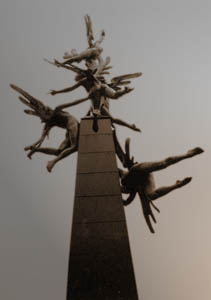
'Axis Mundi' consists of a 20' high polished black granite obelisk
surrounded by a group of five bronze winged figures. The overall
height of the sculpture is 30'. The figure group weighs 1750 lbs
but it is composed and engineered to give the impression that each figure is flying and ascending. At a height of about 12' above the ground, the words 'Axis Mundi' are carved into the sides of the obelisk. At eye-level on the south, east and west sides are bronze bowl-shaped sundials which show the hours of the day, the equinoxes and the twelve astrological signs. On the faces of the bronze pyramid which forms the cap of the obelisk are cast the letters of a palindrome which forms an early Christian secret symbol interpreted by the initiated as the above sign or, in other words, 'Our Father, the Beginning and the End'.
'Axis Mundi' should be understood as a sequel to my 'Frieze of the Wise and Foolish Virgins' which was installed on the facade of number 3, George Street in 1980. In the frieze the Foolish Virgins are portrayed as distracted and dissipated by their various imperfections while the Wise Virgins are shown in a perfect unison of religious conviction as they proceed towards the palindrome. In 'Axis Mundi' the Foolish Virgins have disappeared and the Wise Virgins are shown ascending.
'Axis Mundi' is a religious and philosophical concept. It can be related to the Tree of Life which signifies 'the unfolding of form in a physical sense, development, growth from below upwards ... death and rebirth' (Jung), or to 'the World Tree, the philosophical tree, the tree of Christ's Cross, the Bo-tree of Buddha-hood - and the wounded Fisher King, whose fishline from the Great Above to the Great Below is equally the Axis Mundi; awaiting everywhere, with its baited hook in the water of this world, to haul us up to the lotus boat of the radiant Fisher of Men' (Joseph Campbell).
I began the sculpture by constructing a sketch model 3' high but at this stage it was possible only to approximate the manner in which each figure would be supported by and related to its neighbour. Then a full-size wooden mock-up of the top two metres of the obelisk was built in my studio. The model who posed for all of the figures was the ex-Royal Ballet dancer Linda Sime. In each case she would find the desired pose and I would take measurements for the assembly of an armature of welded steel scaled up by twenty-five per cent. The armature was then attached to the obelisk in the appropriate position and I modelled the figure in clay directly in place. The armatures for the uppermost figures had to be suspended from the ceiling. As each figure was completed, it was moulded and cast into plaster and then refitted to the mock-up of the obelisk with adjustments being made to each figure until the composition was deemed both appropriate and feasible. The idea was always to use the minimum and most subtle systems of support for each figure, concomitant with the principles of good engineering - so that the impression would be of light and airy flight.
The plaster figures, which had been cast in sections, were then disassembled and cast into bronze in my own foundry. The wall thickness of the casting was varied according to the stress and load to which it would be subjected. The wings and extremities, for example, were cast as thinly as possible to save weight, while the load-bearing lower sections were cast much thicker and, in some cases, solid. Contiguous parts were cast integrally with the bronze pyramidal cap of the obelisk which in turn was
attached to a 6' bronze sleeve designed to fit exactly over the reinforced concrete core of the obelisk and which had strong brackets for the attachment of Wise Virgins numbers one and two.
The various parts of the figures were assembled by argon arc welding and the welds were chased out. The uppermost three figures, the pyramid and its sleeve were assembled as one unit in the open air since the group was now too large to fit inside the foundry. In order to achieve full penetration by the welds, the whole group had to be lifted up and held at every possible angle and a crane was hired to effect this.
Once the group and the Wise Virgins numbers one and two were completed, a patina was applied using mercuric chloride and cupric nitrate, which gives a dark and green mottled colouring to the bronze. This patina was chosen in order to create an appropriate contrast with the deep black of the polished granite.
Meanwhile, on site at Tanfield House, the reinforced concrete core of the obelisk had been erected. The bronze figures were transported, supported in a specially made timber cradle, by road to Edinburgh. The main figure group was hoisted into position first, the bronze sleeve carefully lowered over the top of the concrete core and fixed in place, and the other figures attached by bolts and welding. The core was clad with the granite panels, and finally the sundials were installed in prepared recesses. It was considered impractical to unveil this sculpture, so instead a lighting ceremony was held at night, in which the sculpture was slowly revealed by spot- and flood-lights while a choir sang Palestrina's 'Kyrie' from 'Missa Papae Marcelli', a piece of music which may be said to have inspired the sculpture, and a recording of which I played frequently in my studio while I was making it.